
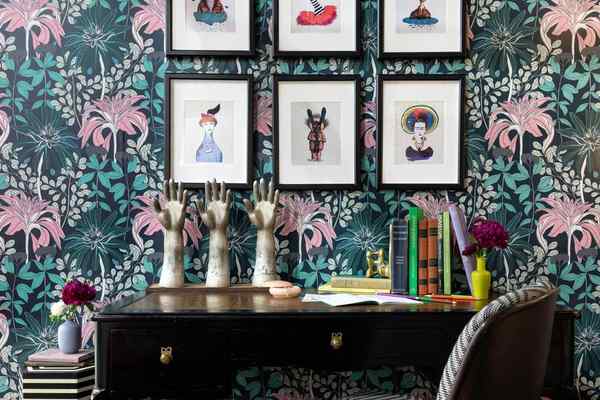
For years, the safest-looking rooms were also the easiest to copy: pale walls, a restrained palette, one sculptural vase, and plenty of empty space. Thoughtful maximalism moves in the opposite direction, but it is not an invitation to fill every surface. It layers colour, pattern, artwork, textiles, and collected objects around a clear point of view. The result feels abundant without feeling accidental.
The renewed interest in maximalist decorating reflects a desire for homes that reveal personality rather than imitate a showroom. The best examples look as though they developed over time. They contain contrast, memory, humour, and visual surprise, yet still support everyday life. Understanding the thoughtful maximalism decorating principles behind the look makes the difference between an expressive room and one that simply feels crowded.
Begin With a Story, Not a Shopping List
A convincing maximalist room usually has an idea at its centre. That might be a love of botanical prints, family travel, inherited furniture, 1970s colour, folk art, or a particular landscape. Starting with a story gives every later decision a filter. Instead of asking whether an object is fashionable, ask whether it strengthens the room’s character.
This is why thoughtful maximalism rarely arrives through a single furniture order. A ceramic bowl from a holiday, a framed child’s drawing, an old side table, and a contemporary lamp can coexist when they contribute to the same emotional narrative. Our guide to finding your interior design style can help clarify that direction.
Use a Controlled Colour Family
Maximalist rooms can contain many colours, but successful schemes usually repeat a smaller group of tones. Choose one dominant colour, one or two supporting colours, and several related accents. They do not need to match exactly. Repetition creates unity.
For example, a living room might begin with deep green walls, then repeat green in a rug and artwork. Rust, plum, and warm pink could appear in smaller doses, while dark wood and aged brass act as grounding neutrals. The room reads as colourful, but the palette remains understandable. This is especially helpful for anyone nervous about eclectic interior styling.
Mix Patterns by Changing Their Scale
Layered decor style depends on variety, not a pile of equally loud prints. Pair a large botanical or scenic pattern with a medium geometric and a small stripe, check, or dot. Changing scale gives the eye places to rest and prevents patterns from competing at the same volume.
Colour should provide the connection. A floral curtain and striped armchair can work together when they share two or three tones. If every print introduces an entirely new palette, the room may feel fragmented. Pattern mixing is easier when one design leads and the others support it.
Create Visual Hierarchy
More objects do not mean every object should demand equal attention. A room needs a focal point, secondary moments, and quieter areas. The focal point might be a gallery wall, patterned sofa, dramatic fireplace, or painted bookcase. Supporting elements should guide the eye toward it rather than fight it.
Stand at the doorway and notice where your attention lands first. If several unrelated items compete immediately, remove or relocate one. Thoughtful editing is not a retreat into minimalism; it allows the strongest pieces to be noticed.
Layer Texture as Carefully as Colour
Texture creates richness even when the palette is restrained. Velvet, linen, wool, lacquer, timber, glass, rattan, stone, and metal reflect light differently and give a room depth. This is also the basis of neutral maximalism, where abundance comes from materials, shapes, and surfaces rather than bright colour.
Try combining a smooth painted cabinet with woven baskets, glossy ceramics, aged books, a nubby rug, and soft curtains. Our guide to mixing textures in interior design offers more combinations for living rooms and bedrooms.
Display Collections With Structure
Collections are central to maximalist decorating because they communicate genuine interests. Structure keeps them from looking like storage. Group items by type, colour, material, or theme, vary their heights, and leave a little space around each group so it reads as a deliberate composition.
Consider a shelf of travel finds. Rather than spreading ten small objects across the room, place them together with a few books and one framed photograph. Use the tallest item at one side, overlap a smaller piece in front, and repeat a colour found elsewhere. The arrangement tells a stronger story and is easier to clean.
Balance Fullness With Functional Breathing Room
A home still needs clear paths, useful tables, comfortable seating, and surfaces where daily tasks can happen. Keep doorways, walkways, radiators, switches, and frequently used drawers unobstructed. A coffee table can hold a tray, books, and an object while still leaving room for a drink.
Breathing room does not always mean a blank wall. It can be a solid-colour cushion between patterned ones, a simple lampshade beside ornate artwork, or a quiet stretch of flooring around a detailed rug. These pauses make the layers feel intentional.
Combine Eras Instead of Recreating One
Thoughtful maximalism is often most convincing when old and new pieces share a room. A contemporary sofa can sit beside an antique chest; traditional wallpaper can support modern photography; a mid-century chair can work beneath a gilded mirror. Mixing periods prevents the space from resembling a themed set.
Look for relationships in line, proportion, material, or colour. Pieces from different eras may still share curved silhouettes or dark timber. Those subtle links create cohesion while preserving visual surprise.
Edit in Rounds
Maximalism needs editing just as much as minimalism. Photograph the room, because a picture often reveals clutter that the eye has learned to ignore. Remove anything damaged, meaningless, awkwardly placed, or present only to fill space. Live with the room for a few days before adding anything back.
A useful rule is to add slowly and subtract confidently. The goal is not the highest possible object count. It is the richest possible expression of the people who live there.
Frequently Asked Questions
What is thoughtful maximalism?
Thoughtful maximalism is an intentional way of layering colour, pattern, texture, art, and personal possessions. It differs from clutter because the room has repetition, hierarchy, function, and a consistent point of view.
Can a small room use maximalist decorating?
Yes. Keep circulation clear, use vertical wall space, group collections rather than scattering them, and choose furniture that suits the room’s scale.
Do maximalist rooms have to be brightly coloured?
No. Neutral maximalism uses layered textures, sculptural shapes, mixed materials, artwork, and collections within a quieter palette. Abundance can come from detail rather than saturated colour.
How do you stop maximalism from looking messy?
Repeat colours, vary pattern scale, create one main focal point, group similar objects, protect functional space, and edit regularly. Every visible item should contribute beauty, meaning, or usefulness.
A More Personal Kind of Abundance
Thoughtful maximalism succeeds when a room feels generous, lived-in, and unmistakably personal. Its discipline is hidden beneath the colour and pattern: a repeated palette, varied scale, visual hierarchy, meaningful collections, and enough open space for the home to function. Build the room in layers, notice what strengthens its story, and remove what distracts from it. The finished space should not simply contain more. It should say more.
