
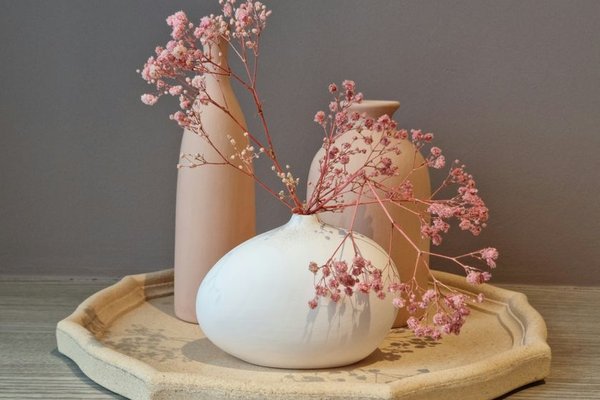
A shelf can hold all the right objects and still feel slightly off. The problem is often not the pieces themselves but the way they have been grouped. That is where the rule of three in interior styling becomes useful. By arranging objects in groups of three, you create enough variation to feel interesting without making the display difficult for the eye to read. It is a simple guideline rather than a rigid formula, which is why it works just as well with treasured personal collections as it does with decorative pieces.
The appeal is especially clear on shelves, consoles, bedside tables, and mantelpieces. Three objects give you room to vary height, shape, material, and meaning while keeping the arrangement visually connected. Better yet, the rule can help personal items look intentional rather than cluttered.
Why groups of three often look balanced
Odd-numbered groupings tend to feel more dynamic than perfectly matched pairs. With three objects, the eye naturally moves from one item to the next instead of stopping at a symmetrical divide. The result can feel relaxed and composed at the same time.
This does not mean every shelf needs exactly three objects. Think of the rule as a way to build small visual units. A stack of books may count as one element, a vase as another, and a framed photograph as the third. The point is to create a relationship among the pieces rather than count every physical object.
Good rule of three decorating also depends on contrast. A more engaging trio might combine a tall ceramic vase, a low stack of books, and a small sculptural object. Their different profiles make each piece easier to see while the group still reads as one composition.
Start with height, then vary shape and texture
One of the easiest shelf styling tips is to choose three elements with noticeably different heights. Begin with the tallest piece, add something mid-height, then finish with a lower object. This creates a gentle visual slope and prevents the group from feeling flat.
Shape and texture add another layer. A glossy rounded vase beside a matte rectangular book and a rough natural object, such as stone or carved wood, creates more depth than three objects with the same finish.
Use one object as the visual anchor
Every trio benefits from a clear starting point. Usually this is the tallest, largest, darkest, or most detailed object. The other two pieces should support it rather than compete for attention.
Imagine a living-room shelf displaying a framed family photograph, two art books, and a small handmade bowl brought home from a trip. Treat the photograph as the anchor. Lay the books horizontally to create a lower platform, then place the bowl partly in front of them. The three elements differ in height and shape, but the personal connection gives the vignette a natural story.
Think in triangles, not straight lines
When styling vignettes, imagine an invisible triangle connecting the three main elements. Place the tallest object toward the back or one side, the medium-height piece near it, and the smallest item slightly forward. This gives the arrangement depth and encourages the eye to move around the display.
Avoid spacing everything at exactly equal intervals. Small overlaps often make a group feel more natural. A bowl can sit partly in front of a book stack, or a small frame can overlap the visual edge of a vase. You are linking the objects so they do not look like unrelated items parked next to one another.
Use the rule of three with personal collections
Homes often feel richer when shelves show souvenirs, inherited pieces, books, ceramics, photographs, and small artworks rather than only matching decor. The challenge is displaying those pieces without letting a collection become visual clutter.
Instead of lining everything across one shelf, edit a collection into smaller groups. Three pieces can create one vignette, while the rest can be rotated or moved elsewhere. This keeps meaningful objects visible without making the shelf feel crowded.
If you collect small ceramics, for instance, group three pieces that differ in height but share a colour family. On the next shelf, use books and a framed print to create a different rhythm. The overall shelving stays cohesive without looking repetitive.
Leave enough empty space around each group
The rule of three works best when the eye can see where one grouping ends and another begins. Empty space is part of the composition. If every gap is filled, even well-arranged trios can merge into clutter.
After styling a shelf, stand several feet away and look at the whole unit rather than individual objects. If two groups seem to run together, remove one piece or increase the gap between them. This quick distance check is one of the most practical ways to refine a display.
Related topics that fit naturally with this approach include styling open shelves, decorating with personal collections, and using texture in interior design.
Know when to break the rule
No design guideline should make a room feel mechanical. A pair of candlesticks may look perfect on a narrow mantel, while a large collection of books may work better as one substantial block. The rule of three is most helpful when a surface feels unfinished, overly symmetrical, or cluttered and you need a simple framework for editing it.
You can also create three larger zones rather than three individual objects. On a long console, a lamp can form the first zone, a grouped stack of books and decorative object can form the second, and a vase of branches can form the third.
Frequently asked questions
What is the rule of three in interior styling?
It is a decorating guideline that groups objects in threes to create visual balance, movement, and variety. The three elements do not need to be identical or even the same type of object.
Do I need exactly three items on every shelf?
No. A group of three is simply one useful composition. You can combine several items into one visual element, leave some shelves sparse, or use other odd-numbered groupings when they suit the space better.
How do I make three objects look connected?
Vary their heights, use contrast in shape or texture, and place them close enough to read as a group. A shared colour, material, theme, or personal story can also create a visual connection.
Can the rule of three work in small spaces?
Yes. Choose smaller objects and keep breathing room around the grouping. A simple trio on a bedside table or narrow ledge can feel styled without making the surface crowded.
A simple framework for more personal shelves
The best shelves rarely look as though they were arranged by a formula. They feel balanced, personal, and easy on the eye. The rule of three gives you a practical starting point: choose an anchor, vary height and shape, create a loose triangle, and leave space around the group. From there, let the objects themselves tell the story. When meaningful pieces are edited into small, intentional arrangements, a shelf becomes more than decoration; it becomes a quiet record of the people, places, and things that matter in the room.
